On this page
Jump to a section:
Advertisement
1. What is the Golden Ratio?
Phi (ϕ) is approximately 1.618 and appears in math, nature, art, and design.
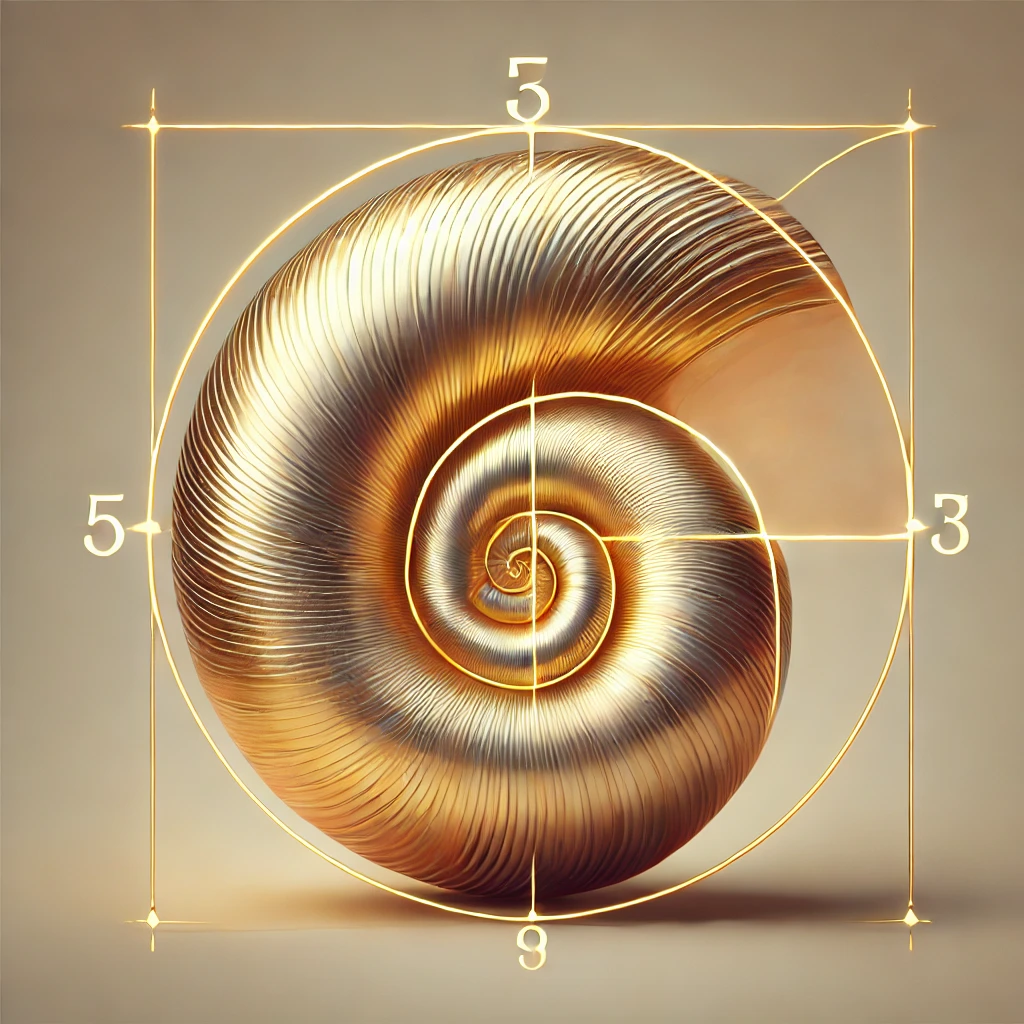
The Golden Ratio is a mathematical constant symbolized by the Greek letter Phi (ϕ), approximately equal to 1.618.
It describes a special relationship: when you divide a line so that the ratio of the whole to the larger part equals
the ratio of the larger part to the smaller part, that ratio is Phi. Expressed algebraically, if a > b, then
(a + b) / a = a / b = ϕ ≈ 1.6180339887.
The number has fascinated mathematicians since Euclid described it in the Elements around 300 BC, where it appears
as the "extreme and mean ratio." It is closely tied to the Fibonacci sequence (1, 1, 2, 3, 5, 8, 13, 21…): divide any Fibonacci
number by the one before it, and the result gets closer and closer to 1.618 as the numbers grow. This connection is why
Phi-like spirals show up in sunflower seed heads, pinecones, and nautilus shells.
In art and design, the Golden Ratio has long been used as a composition aid. Renaissance artists studied it under the name
"divine proportion," and modern designers still use golden rectangles and spirals to guide layouts, logos, and photography
crops. Whether it is truly "the most beautiful ratio" is debated—but as a practical reference for balanced proportion,
it has remarkable staying power across two millennia.
2. How Facial Proportions Are Measured
Vertical thirds, horizontal fifths, and the length-to-width ratio our analyzer reports.
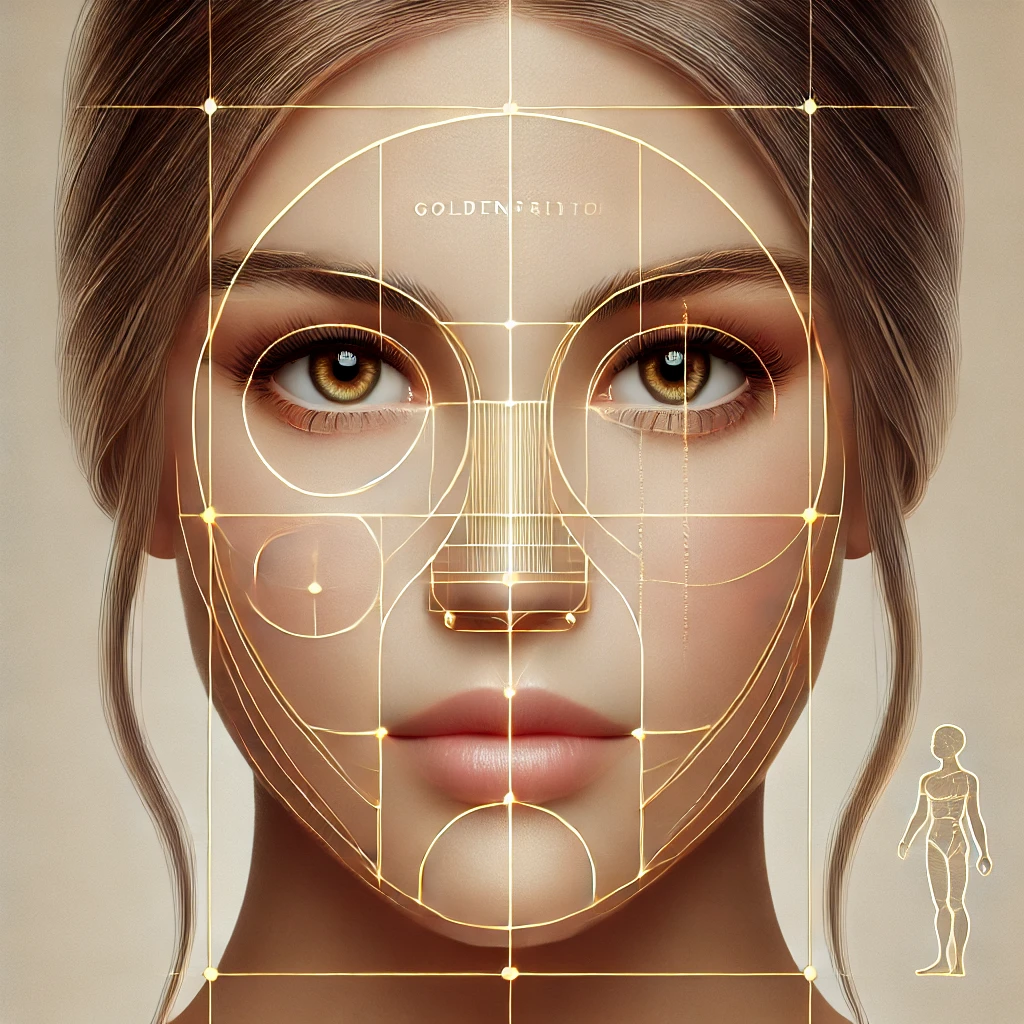
When people talk about a "golden ratio face," they usually mean one of a few classical measurement systems. The most common
is the length-to-width ratio: the distance from hairline to chin divided by the widest span of the face
(usually across the cheekbones). Phi enthusiasts consider ≈1.618 ideal, though measured the way our analyzer does (from the top
of the face outline to the chin), real faces cluster between about 1.05 and 1.35—which is exactly what you'll see in
our celebrity benchmark table. Tape measurements taken from the hairline read higher, around 1.3–1.5, but still
nowhere near Phi.
A second system divides the face into vertical thirds: hairline to eyebrows, eyebrows to the base of the nose,
and nose base to chin. In classical canons these thirds are roughly equal, and noticeable imbalance between them changes how
long or short a face reads. A third system, the rule of horizontal fifths, divides the face across into five
eye-widths: ideally, the space between the eyes equals one eye width, and each eye sits one eye-width from the edge of the face.
Modern tools like our Face Ratio Analyzer automate these measurements using facial landmark
detection: the AI locates hundreds of points on your face (eye corners, nose base, jawline, chin) and computes distances and
ratios between them. This removes the guesswork of holding a ruler to a photo—but remember that camera angle, lens distortion,
and hair covering the face outline all shift landmarks, which is why two photos of the same person can produce slightly
different numbers.
Advertisement
3. Applications in Modern Beauty
Makeup, hair, cosmetic consultation, and digital analysis tools all borrow from Phi.
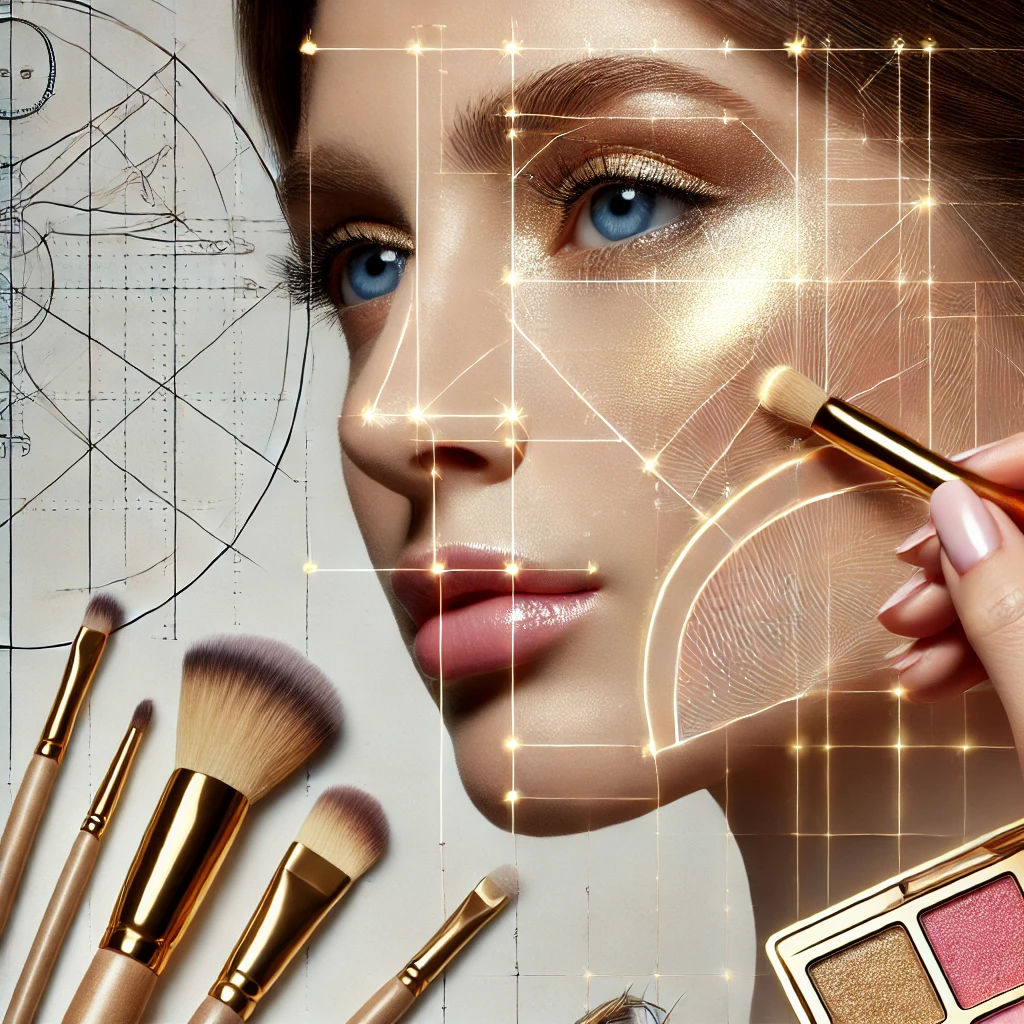
The Golden Ratio shows up constantly in modern beauty practice, even when it isn't named. Makeup artists use
proportional thinking every day: brow mapping places the start, arch, and tail of the eyebrow along lines drawn from the nose
and eye; contouring narrows a wide mid-face or shortens a long chin; and lip liner can shift the balance between upper and
lower lip toward the classical 1:1.6 relationship.
Hairstylists apply the same logic at a larger scale. Volume at the crown adds visual length to a round face,
while side-swept layers add width to a long one—each choice nudges the perceived length-to-width ratio without changing the face
at all. This is why we recommend reading our styling tips by face shape right after you get
your analyzer result: the ratio tells you which direction to nudge.
In aesthetic consultation, practitioners sometimes use Phi-based masks and landmark grids as a
communication tool—a shared vocabulary for describing proportions. And of course, digital analysis
tools like ours use landmark detection to report your measurements instantly. In every case the ratio works best as a
descriptive aid, not a prescription: the goal is balance that suits your face, not conformance to a constant.
4. What Science Actually Says
Symmetry and averageness matter; a single magic number does not.

Research on facial attractiveness consistently identifies a few robust factors. Symmetry—how closely the left
and right halves of a face mirror each other—correlates with attractiveness ratings across many studies and cultures.
Averageness is even more powerful: composite faces created by blending many individual faces are reliably rated
as more attractive than most of the faces used to create them, likely because averaged features are smooth, symmetric, and easy
for the brain to process.
Other well-supported factors include skin evenness (clear, uniform skin reads as healthy at any age),
sexual dimorphism (feature patterns typical of one's sex), and simple grooming and expression effects—a genuine
smile measurably raises attractiveness ratings. Notice what's missing from this list: no study has established Phi itself as a
universal attractiveness threshold.
When researchers have tested Golden Ratio claims directly—measuring attractive faces to see if they cluster at 1.618—results
have been mixed at best. Some studies find preferred length-to-width ratios well below Phi; others find that preferences vary
with the population studied. The honest summary: humans clearly prefer proportion, symmetry, and balance, and Phi is one
historically popular way to talk about those things—but it is a landmark on the map, not the destination.
5. Debates and Limitations
Why the Golden Ratio is interesting—but not a universal standard for beauty.
The strongest criticism of the "golden face" idea is selection bias: with dozens of measurable distances on any
face, you can almost always find some pair that divides close to 1.618—and ignore the many pairs that don't. Skeptics
point out that the same trick "finds" Phi in the Parthenon, the pyramids, and famous paintings whose creators never mentioned it.
Culture and era matter enormously. Beauty ideals shift across decades and differ between regions—compare the
celebrated faces of 1990s Hollywood with today's, or Western preferences with East Asian ones, where a smaller overall face
(the familiar "small face" compliment in Korea and Japan) carries weight that a Phi calculation never captures. A single
constant cannot describe a moving, culturally embedded target.
Finally, measurement itself is fragile: hairline position is ambiguous, camera lenses distort proportions
(a phone selfie at arm's length widens the nose and narrows the jaw), and expression changes vertical measurements. That's why
our analyzer encourages comparing photos taken under similar conditions. Use the Golden Ratio as a lens for
understanding proportion—then set it down. Many of the world's most memorable faces are memorable precisely because they
break the rules.
6. How to Read Your Own Analyzer Results
Turn your numbers into practical, confidence-building decisions.
When you run the Face Ratio Analyzer, you'll get a length, width, and ratio. Here's a practical
way to interpret them. A ratio around 1.15 or below reads as a rounder or squarer face: styling that adds height
(crown volume, vertical lines, deeper partings) creates balance. A ratio between about 1.15 and 1.25 reads as oval:
most styles work. Above roughly 1.25 the face reads longer, and added width helps (side volume, waves, horizontal
fringe). Compare your numbers with the celebrity benchmarks on the home page—you'll notice admired faces scattered across the
whole 1.11–1.28 range.
Whatever your number, treat it as a starting point for styling experiments, not a grade. Re-test with a consistent front-facing
photo after changing one variable (parting, fringe, hair length) and see how the perceived proportions shift. Then explore our
styling guide and skincare routine to work on the factors that
research actually supports: grooming, skin quality, and balance.
Next recommended pages
Continue with related guides:
FAQ
Phi (ϕ) is a constant of approximately 1.618. It appears when the ratio of a whole to its larger part equals the ratio of the larger part to the smaller part.
There is no single good number. Measured with our analyzer, real faces fall roughly between 1.05 and 1.35 — every celebrity in our benchmark sits between 1.11 and 1.28 — and attractive faces exist across that whole range. Phi (1.618) is a classical reference point, not a target.
No. It can be a reference for discussing balance, but attractiveness is multi-dimensional and varies by person and culture. Research supports symmetry, averageness, and skin quality far more strongly than any single ratio.
Advertisement