First: why your face looks bigger in photos
Half of the "big face" problem is optics, not anatomy.
Phone front cameras are wide-angle lenses, and wide-angle lenses used close up exaggerate whatever is nearest to them — usually your nose and cheeks — while compressing the edges of the frame. The same face photographed at arm's length and from two meters away can look like two different people. Korean beauty culture's obsession with "small faces" (eolgul-i jakda is one of the standard compliments) is fought largely with optics: angles, framing, and styling that change how big the face reads, not how big it is.
That's good news, because every lever below is available to you today. If you want a baseline first, measure your actual face size with the AI analyzer — you may find your face is far more average than your selfies suggest.
The five levers
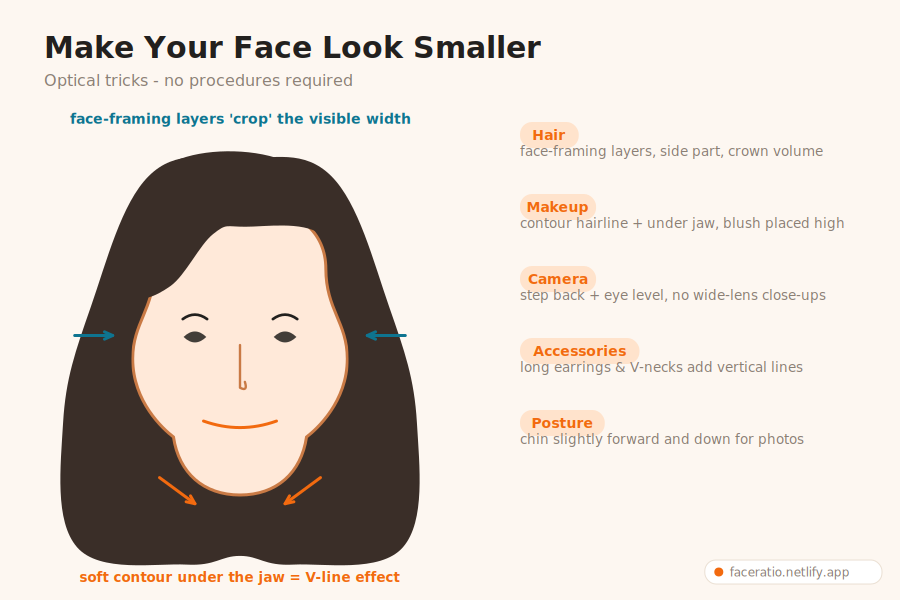
1. Hair: crop the visible area. Face-framing layers are the single most effective tool — strands falling in front of the temples and cheeks literally reduce the visible surface of the face. Add moderate volume at the crown (height makes width read narrower by comparison) and consider a side part, which breaks the symmetrical "full moon" presentation. Avoid scraping everything back into a tight, flat style if width bothers you.
2. Makeup: shade the borders. A soft contour powder one or two shades deeper than your skin, swept along the hairline and under the jaw, visually pulls both boundaries inward — the classic K-beauty "small face" (소안) routine. Blush placed slightly high and angled toward the temples adds a diagonal that lengthens; highlighter stays on the center strip (forehead, nose bridge, chin) to bring the middle forward.
3. Camera: distance and angle. Step back and zoom in slightly rather than shooting close; hold the camera at eye level or a touch above; and turn your face 10–15 degrees off straight-on — the three-quarter angle is beloved by portrait photographers precisely because it slims the face. Video calls: push the laptop farther away and raise it to eye height.
4. Accessories: add vertical lines. Long drop earrings, V-necklines, and open collars all draw the eye up and down. Oversized glasses frames make the face behind them read smaller by contrast — one reason the oversized-frame trend keeps returning in Seoul street fashion.
5. Posture: chin forward-and-down. The photographer's classic. Extending your chin slightly forward and tipping it down separates the jawline from the neck, sharpening the face outline instantly. Practice it once in a mirror — it feels absurd and photographs beautifully.
What doesn't work (and what to skip)
Extreme filters shrink your face in the photo and nowhere else — and the gap between filtered and real appearance tends to make people more self-conscious, not less. Face-slimming massage tools and "V-line" gadgets mostly move temporary fluid; any change is gone by evening. And comparing your arm's-length selfie to a celebrity's professionally shot photo is comparing two different lenses, two different distances, and a lighting crew — not two faces.
Perspective helps too: our celebrity measurements show that even famous "small faces" measure quite ordinary numbers once the camera tricks are stripped away. Work the levers above, then let it go — proportion and grooming carry far more of the impression than raw size does.
Next recommended pages
Continue with related guides: