The one rule behind every recommendation
Contrast the frame with your face — don't repeat it.
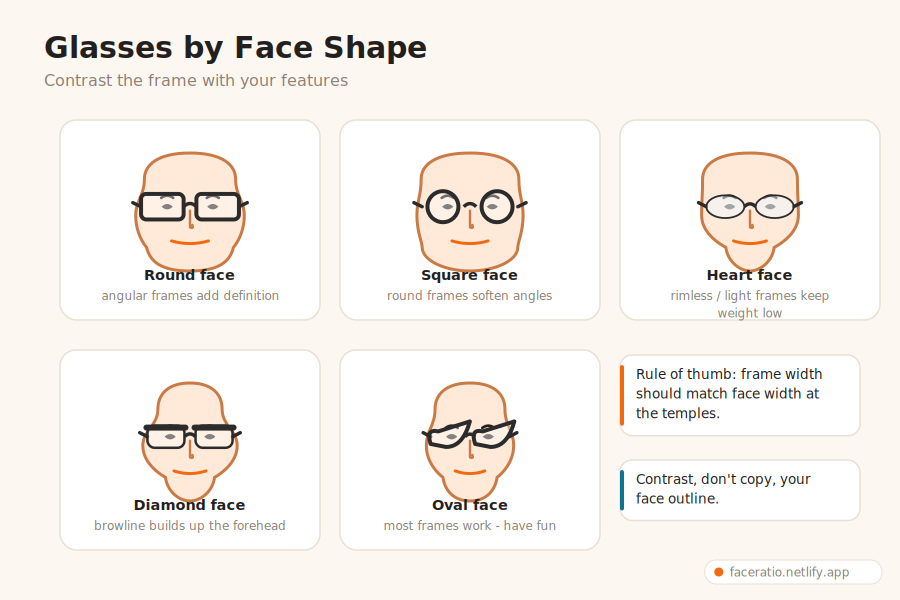
Nearly all eyewear advice reduces to a single principle: choose frames that contrast with your face's dominant lines. Round features gain definition from angular frames; angular features soften behind curves. Add two sizing rules — frame width should roughly match your face width at the temples, and your eyes should sit near the center of each lens — and you can walk into any optician armed.
Don't know your face shape yet? Two minutes with our face shape guide (or one photo in the AI analyzer) settles it.
Recommendations by face shape
Round face — go angular: rectangular and square frames add the structure round features lack, and a frame that's wider than it is tall stretches the face horizontally less than you'd fear while adding definition. Skip small round lenses, which repeat and amplify the roundness.
Square face — go curved: round, oval, and softly-cornered frames counterbalance a strong jaw. Thinner rims and metal frames keep the look light. Boxy, heavy-rimmed rectangles stack angles on angles — striking if you want drama, harsh if you don't.
Heart face — keep visual weight low: bottom-heavy frames, rimless or half-rim styles, and light colors stop the top half of the face from dominating. Aviators, wider at the top with a tapering line, happen to mirror the heart shape's geometry and are a classic match. Avoid ornate browlines and top-heavy decoration.
Diamond face — build up the forehead: browline frames, cat-eyes, and anything with detail along the top edge widen the narrow brow zone and balance prominent cheekbones. Rimless styles also work by not competing with the cheekbones at all.
Oval face — you're the fitting model: most shapes work, so optimize for size and proportion instead. Frames as wide as your face, lenses that don't swallow your eyebrows, and whatever personality you want your glasses to project — retro round, sharp cat-eye, minimalist titanium — all sit well on balanced proportions.
Fit details people forget
Eyebrows: the frame's top edge should sit just below or along your brow line — never cut through the middle of it. Pupils: centered in the lens, horizontally and vertically; if your pupils sit in the top half of the lens, the frame is too large or sitting too low. Nose bridge: low nose bridges (common in East Asian faces) are why "Asian fit" frames exist, with taller nose pads and shorter lens depth — they prevent glasses sliding down and lenses touching cheeks.
Finally, glasses interact with hair: a fringe plus a heavy browline frame crowds the upper face, while pulled-back hair gives statement frames room to work. If you're changing both, read this together with the hairstyle guide for your shape.
Next recommended pages
Continue with related guides: