Step 1: Get your two numbers
Everything starts with face length, face width, and their ratio.
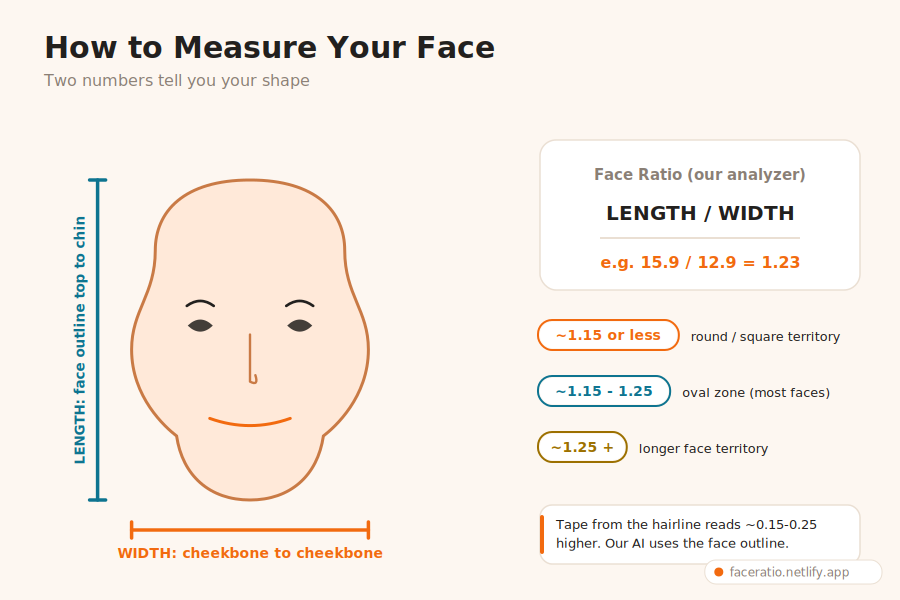
Your face shape comes down to two measurements. Length: from the middle of your hairline straight down to the tip of your chin. Width: across your face at the widest point of your cheekbones. Divide length by width and you have your face ratio — the single most useful number in this guide.
You can do this with a soft measuring tape and a mirror (keep the tape flat, don't follow the curve of your face), or skip the tape entirely: our free AI analyzer detects your facial landmarks from one front-facing photo and calculates length, width, and ratio in seconds, right in your browser.
Method note: the analyzer measures length from the top of the detected face outline (mid-forehead) to the chin, not from the hairline. A tape measurement from the hairline typically reads about 0.15–0.25 higher — the thresholds in this guide use the analyzer's convention.
Step 2: Follow the two questions
Ratio first, then the widest point — that's the whole method.
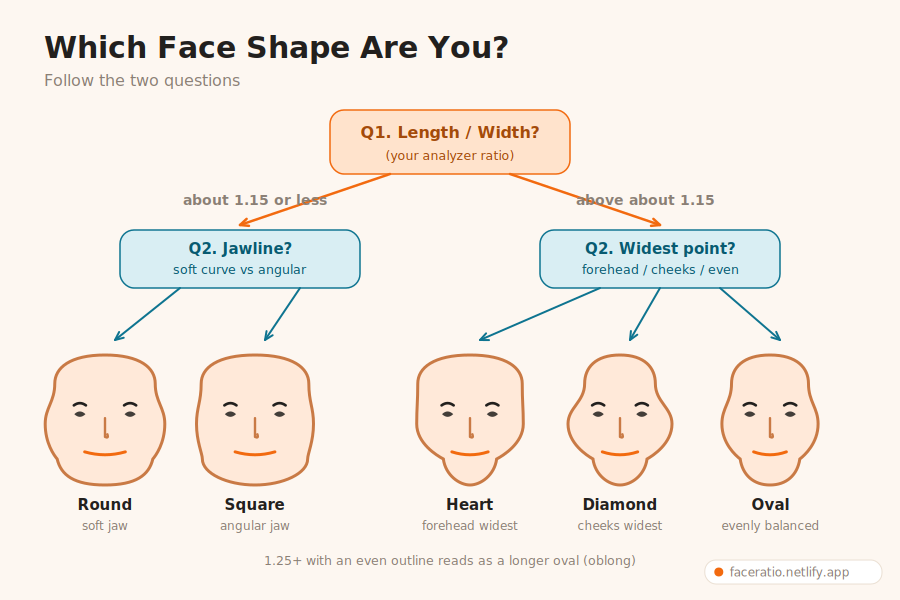
Question 1 — What's your ratio? If it's roughly 1.15 or below, your face is nearly as wide as it is long: round/square territory (for reference, Don Lee measures 1.11 and BTS's JIMIN 1.15 with this tool). If it's above about 1.15, your face is clearly longer than wide: oval, heart, or diamond territory — Cha Eun-woo (1.23) and Kim Soo-hyun (1.28) live here. Above roughly 1.25 with an even outline, the face reads as a longer oval (oblong).
Question 2 — Where are you widest? For the shorter ratios: a soft, curved jawline means round; a flat, angular jawline with a broad forehead means square. For the longer ratios: widest at the forehead with a tapering chin is heart; widest at the cheekbones with a narrow forehead and chin is diamond; width distributed evenly with gentle tapering is oval; and a very long face with fairly straight sides is oblong.
Tie-breaker tip: pull all your hair back and trace your face outline on a mirror selfie with your finger (or a lipstick on the actual mirror — the classic trick). The outline you draw is usually more honest than the one you imagine.
The six shapes at a glance
| Shape | Ratio | Key markers | Styling priority |
|---|---|---|---|
| Round | ~1.15 or less | soft jaw, full cheeks | add height and vertical lines |
| Square | ~1.15 or less | angular jaw, broad forehead | soften angles with waves — or own them |
| Oval | ~1.15–1.25 | balanced, gently tapered | almost anything works |
| Oblong | ~1.25+ | long, straight sides | add width, avoid extra height |
| Heart | ~1.15–1.25 | wide forehead, pointed chin | volume near the jaw, curtain fringe |
| Diamond | ~1.15–1.25 | high cheekbones, narrow forehead & chin | widen forehead and jaw |
Ranges use our analyzer's measurement and are calibrated against the celebrity data on this site. Real faces blend categories — that's normal.
Common mistakes when self-identifying
Mistake 1: judging with hair down. Fringes hide the forehead and side layers hide the jaw — the two zones that decide your category. Always assess with hair fully pulled back.
Mistake 2: using a selfie taken at arm's length. Phone front cameras are wide-angle lenses; up close they bulge the center of the face and shrink the edges, making every face look longer and narrower than it is. Stand back, use the rear camera or a timer, and keep the camera at eye level.
Mistake 3: expecting one clean answer. Most people are a blend — "oval with a square jaw" or "round leaning heart." That's fine. Take the styling advice of your dominant shape and borrow from the secondary one where it fits. The measurements are a vocabulary, not a verdict.
What to do with your answer
Once you know your shape, three guides on this site turn it into decisions: hairstyles by face shape covers cuts, partings, and fringes for each category; glasses by face shape applies the same balance logic to frames; and if your goal is a smaller-looking face overall, see how to make your face look smaller.
And if you haven't measured yet — the AI analyzer takes about fifteen seconds, runs entirely in your browser, and gives you the exact numbers this guide is built around.
Next recommended pages
Continue with related guides: